
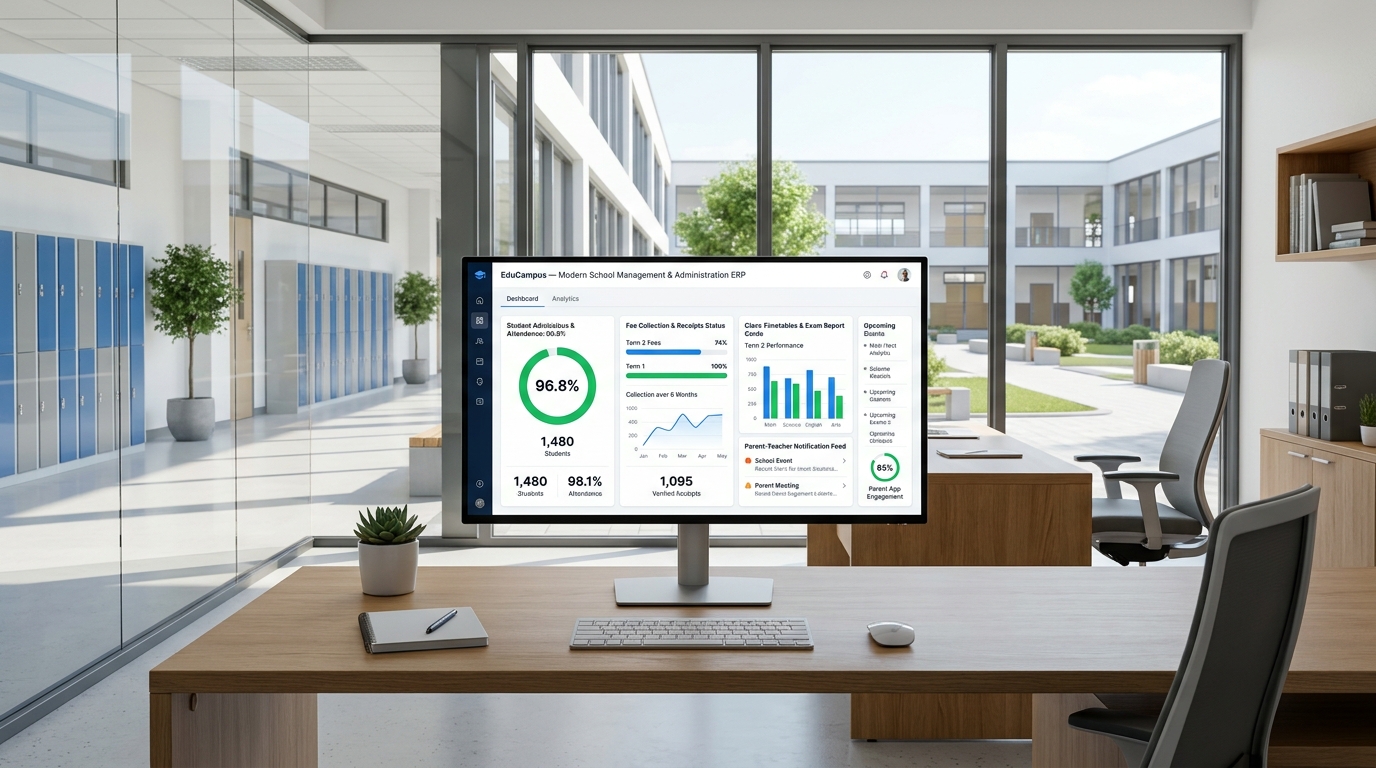
Managing a school involves several activities, including student admissions, attendance tracking, fee collection, examinations, academic records, teacher coordination, and parent communication. Handling all these activities manually can consume valuable time and increase the chances of errors.
A School Management System helps educational institutions manage their daily administrative and academic activities through a single digital platform. It reduces paperwork, improves communication, and makes school operations more organised and efficient.
Whether it is a primary school, high school, or higher secondary institution, choosing the right school management software can make a significant difference in everyday operations.
10 Essential Features of a Modern School Management System
1. Student Admission Management
A school management system should simplify the student admission process. It should allow schools to maintain admission applications, student details, document records, and class allocation in one place. This makes student registration easier and reduces manual paperwork.
2. Student Attendance Management
Attendance tracking is an essential part of school administration. The software should allow teachers to record daily student attendance and generate attendance reports. It also helps schools monitor absenteeism and share attendance updates with parents.
3. Fee Management and Payment Tracking
Managing school fees manually can become complicated. A good school management system should support fee collection, payment records, pending fee tracking, receipts, and fee reports. This helps schools maintain accurate financial records and simplifies fee administration.
4. Examination and Result Management
Examination management features help schools organise tests, examinations, marks entry, grade calculations, and report card generation. Teachers can update student marks, while administrators can generate academic performance reports efficiently.
5. Timetable and Class Management
Creating and managing class timetables is important for smooth academic operations. The system should allow schools to organise subjects, teachers, classrooms, and class schedules. This helps avoid timetable conflicts and improves academic planning.
6. Teacher and Staff Management
Schools need an organised way to manage teachers and administrative staff. The software should maintain staff profiles, attendance, schedules, assigned subjects, and other employment-related records. This makes staff administration more efficient.
7. Parent and Teacher Communication
Effective communication between parents and teachers supports better student development. A school management system should provide notifications, announcements, messages, and academic updates. Parents can stay informed about attendance, examination results, school events, and important notices.
8. Homework and Assignment Management
Digital homework management allows teachers to share assignments, study materials, and learning resources with students. Students can access their tasks, while teachers can monitor assignment submissions and completion.
9. Library Management
A school library management feature helps maintain book records, student borrowing details, issue dates, return dates, and overdue information. It makes library operations easier and helps schools manage their learning resources effectively.
10. Reports and Analytics
A modern school management system should generate reports related to student attendance, academic performance, fee collection, admissions, and staff activities. These reports help school administrators understand institutional performance and make informed decisions.
Why Is a School Management System Important for Modern Educational Institutions?
As educational institutions grow, managing students, teachers, fees, examinations, and administrative activities becomes increasingly challenging. A centralised school management system connects these activities and provides easy access to important information.
It reduces repetitive administrative work, improves data organisation, saves time, and supports better coordination between school management, teachers, students, and parents.
Choose the Right School Management Software for Your Institution
Selecting the right school management software is essential for improving institutional efficiency. Schools should look for a solution that offers student information management, admission processing, attendance tracking, fee management, examination management, timetable scheduling, parent communication, and reporting facilities.
At NextGenPro, we develop smart ERP and software solutions designed to simplify organisational operations. With over 16 years of experience in technology and software solutions, NextGenPro focuses on delivering practical digital solutions that support educational institutions in managing their daily activities more efficiently.
Investing in a reliable school management system helps schools reduce administrative complexity, improve operational efficiency, and create a more organised learning environment.
Empower Your Institution with NextGenPro School ERP
Discover how NextGenPro School Management Software streamlines admissions, attendance, fees, examinations, timetables, and parent communication on one unified platform.

